Family Guy I Never Met a Dead Woman Cardboard Gif
My Family unit'south Slave
She lived with united states of america for 56 years. She raised me and my siblings without pay. I was 11, a typical American kid, before I realized who she was.
点击这里阅读中文版本 (Chinese) | Basahin ang artikulong ito sa Tagalog (Tagalog)
Alex Tizon passed abroad in March. He was a Pulitzer Prize–winning journalist and the author of Large Little Man: In Search of My Asian Self. For more about Alex, please see this editor's note.
The ashes filled a black plastic box about the size of a toaster. It weighed three and a half pounds. I put it in a sheet tote bag and packed it in my suitcase this past July for the transpacific flight to Manila. From there I would travel by automobile to a rural hamlet. When I arrived, I would hand over all that was left of the adult female who had spent 56 years equally a slave in my family'due south household.
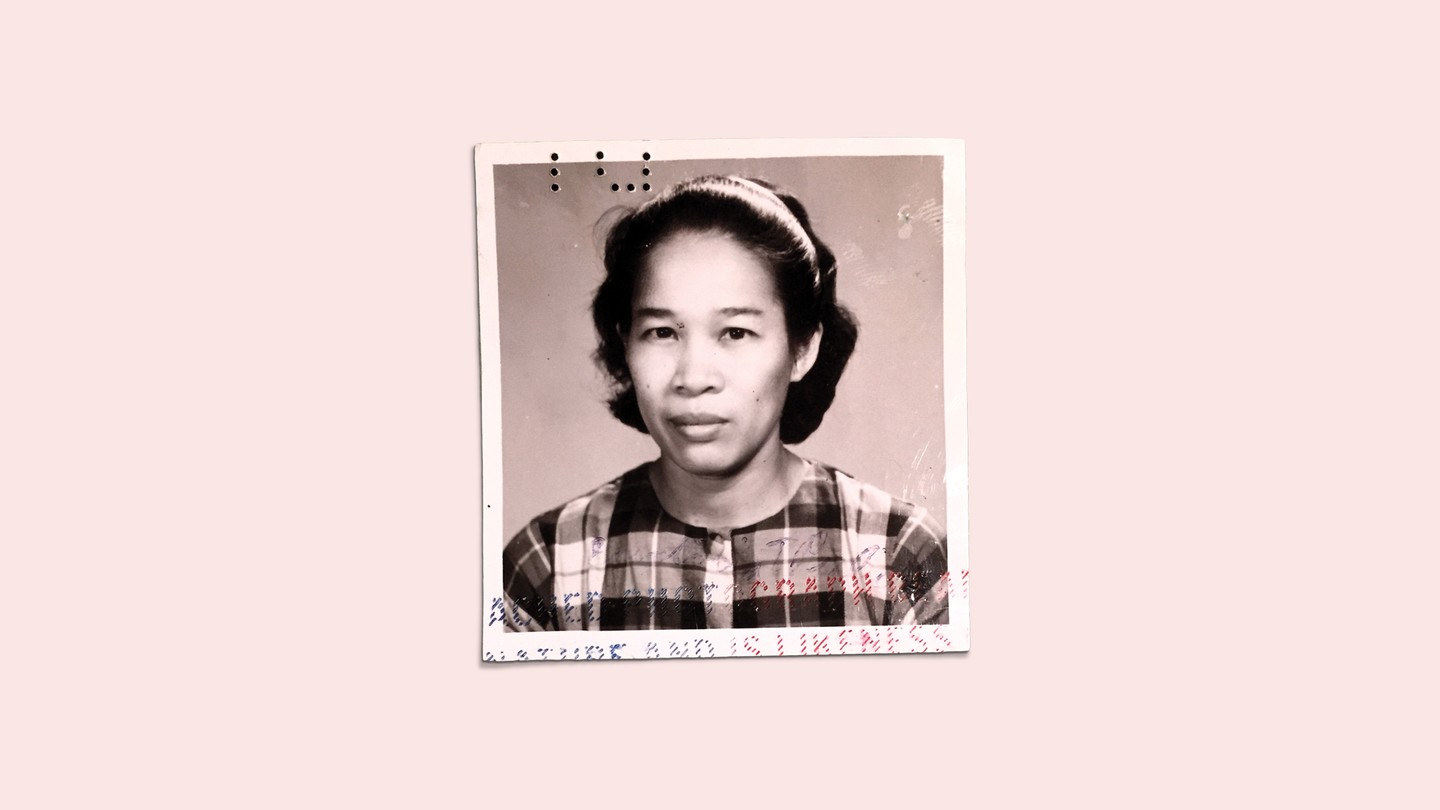
Her proper name was Eudocia Tomas Pulido. We called her Lola. She was 4 human foot xi, with mocha-brownish peel and almond eyes that I can still see looking into mine—my get-go memory. She was 18 years old when my grandad gave her to my mother as a gift, and when my family moved to the United states, we brought her with us. No other word but slave encompassed the life she lived. Her days began earlier everyone else woke and ended later we went to bed. She prepared three meals a 24-hour interval, cleaned the house, waited on my parents, and took care of my iv siblings and me. My parents never paid her, and they scolded her constantly. She wasn't kept in leg irons, but she might equally well have been. So many nights, on my mode to the bath, I'd spot her sleeping in a corner, slumped against a mound of laundry, her fingers clutching a garment she was in the middle of folding.
Heed to the audio version of this article:
Feature stories, read aloud: download the Audm app for your iPhone.
To our American neighbors, we were model immigrants, a poster family. They told us and then. My father had a law degree, my mother was on her way to becoming a doctor, and my siblings and I got good grades and e'er said "please" and "thank you." Nosotros never talked virtually Lola. Our hush-hush went to the core of who we were and, at to the lowest degree for united states kids, who nosotros wanted to be.
After my mother died of leukemia, in 1999, Lola came to alive with me in a small town north of Seattle. I had a family, a career, a house in the suburbs—the American dream. And then I had a slave.
At luggage claim in Manila, I unzipped my suitcase to make sure Lola's ashes were still there. Outside, I inhaled the familiar smell: a thick blend of frazzle and waste product, of sea and sweet fruit and sweat.
Early the next forenoon I establish a commuter, an affable middle-aged homo who went by the nickname "Doods," and we striking the route in his truck, weaving through traffic. The scene always stunned me. The sheer number of cars and motorcycles and jeepneys. The people weaving between them and moving on the sidewalks in swell dark-brown rivers. The street vendors in bare feet trotting alongside cars, hawking cigarettes and cough drops and sacks of boiled peanuts. The child beggars pressing their faces against the windows.
Doods and I were headed to the place where Lola's story began, up north in the primal plains: Tarlac province. Rice country. The home of a cigar-chomping army lieutenant named Tomas Asuncion, my grandfather. The family stories paint Lieutenant Tom equally a formidable man given to eccentricity and dark moods, who had lots of land but piffling money and kept mistresses in separate houses on his property. His wife died giving birth to their only kid, my mother. She was raised by a series of utusans, or "people who take commands."
Slavery has a long history on the islands. Before the Spanish came, islanders enslaved other islanders, usually war captives, criminals, or debtors. Slaves came in dissimilar varieties, from warriors who could earn their freedom through valor to household servants who were regarded as holding and could be bought and sold or traded. High-status slaves could own low-status slaves, and the depression could own the lowliest. Some chose to enter servitude but to survive: In exchange for their labor, they might be given food, shelter, and protection.
When the Spanish arrived, in the 1500s, they enslaved islanders and later brought African and Indian slaves. The Castilian Crown eventually began phasing out slavery at home and in its colonies, just parts of the Philippines were and so far-flung that regime couldn't keep a shut eye. Traditions persisted under unlike guises, fifty-fifty afterward the U.S. took control of the islands in 1898. Today fifty-fifty the poor can take utusans or katulongs ("helpers") or kasambahays ("domestics"), as long equally there are people even poorer. The pool is deep.
Lieutenant Tom had equally many as three families of utusans living on his property. In the spring of 1943, with the islands under Japanese occupation, he brought dwelling house a girl from a village down the road. She was a cousin from a marginal side of the family, rice farmers. The lieutenant was shrewd—he saw that this girl was penniless, unschooled, and likely to be malleable. Her parents wanted her to marry a pig farmer twice her historic period, and she was desperately unhappy but had nowhere to go. Tom approached her with an offering: She could have nutrient and shelter if she would commit to taking care of his daughter, who had just turned 12.
Lola agreed, non grasping that the deal was for life.
"She is my gift to y'all," Lieutenant Tom told my mother.
"I don't want her," my mother said, knowing she had no choice.
Lieutenant Tom went off to fight the Japanese, leaving Mom backside with Lola in his creaky house in the provinces. Lola fed, groomed, and dressed my mother. When they walked to the market, Lola held an umbrella to shield her from the lord's day. At night, when Lola'southward other tasks were washed—feeding the dogs, sweeping the floors, folding the laundry that she had washed by mitt in the Camiling River—she sat at the edge of my mother's bed and fanned her to sleep.
One day during the war Lieutenant Tom came home and caught my mother in a lie—something to do with a boy she wasn't supposed to talk to. Tom, furious, ordered her to "stand at the tabular array." Mom cowered with Lola in a corner. And then, in a quivering vocalisation, she told her father that Lola would take her penalty. Lola looked at Mom pleadingly, so without a word walked to the dining table and held on to the edge. Tom raised the chugalug and delivered 12 lashes, punctuating each one with a word. Yous. Exercise. Not. Lie. To. Me. You. Do. Not. Prevarication. To. Me. Lola made no audio.
My mother, in recounting this story belatedly in her life, delighted in the outrageousness of it, her tone seeming to say, Tin you believe I did that? When I brought it up with Lola, she asked to hear Mom's version. She listened intently, eyes lowered, and afterward she looked at me with sadness and said only, "Yes. It was like that."
Seven years afterwards, in 1950, Mom married my begetter and moved to Manila, bringing Lola along. Lieutenant Tom had long been haunted by demons, and in 1951 he silenced them with a .32‑quotient slug to his temple. Mom almost never talked most it. She had his temperament—moody, majestic, secretly delicate—and she took his lessons to heart, among them the proper manner to be a provincial matrona: Y'all must embrace your role every bit the giver of commands. You must continue those beneath you in their place at all times, for their own adept and the good of the household. They might cry and mutter, simply their souls volition thank you. They volition love you lot for helping them be what God intended.
My brother Arthur was born in 1951. I came next, followed by three more siblings in rapid succession. My parents expected Lola to be every bit devoted to us kids as she was to them. While she looked subsequently us, my parents went to school and earned advanced degrees, joining the ranks of so many others with fancy diplomas just no jobs. So the large break: Dad was offered a chore in Foreign Affairs as a commercial analyst. The salary would be meager, but the position was in America—a place he and Mom had grown up dreaming of, where everything they hoped for could come up true.
Dad was allowed to bring his family and one domestic. Figuring they would both have to work, my parents needed Lola to care for the kids and the house. My mother informed Lola, and to her dandy irritation, Lola didn't immediately acquiesce. Years afterward Lola told me she was terrified. "Information technology was too far," she said. "Maybe your Mom and Dad won't let me get domicile."
In the end what convinced Lola was my male parent'southward promise that things would be different in America. He told her that every bit soon every bit he and Mom got on their anxiety, they'd give her an "allowance." Lola could send money to her parents, to all her relations in the village. Her parents lived in a hut with a dirt flooring. Lola could build them a concrete house, could change their lives forever. Imagine.
We landed in Los Angeles on May 12, 1964, all our belongings in cardboard boxes tied with rope. Lola had been with my female parent for 21 years past then. In many ways she was more of a parent to me than either my female parent or my begetter. Hers was the outset face I saw in the morning and the last i I saw at night. As a babe, I uttered Lola'southward name (which I start pronounced "Oh-ah") long earlier I learned to say "Mom" or "Dad." Equally a toddler, I refused to go to sleep unless Lola was holding me, or at to the lowest degree nearby.
I was iv years old when nosotros arrived in the U.S.—too immature to question Lola's place in our family unit. Simply as my siblings and I grew upward on this other shore, we came to see the world differently. The leap across the ocean brought about a spring in consciousness that Mom and Dad couldn't, or wouldn't, make.
Lola never got that allowance. She asked my parents most information technology in a roundabout way a couple of years into our life in America. Her mother had fallen ill (with what I would later learn was dysentery), and her family couldn't afford the medicine she needed. "Pwede ba?" she said to my parents. Is it possible? Mom permit out a sigh. "How could you even ask?," Dad responded in Tagalog. "You see how hard up we are. Don't you have any shame?"
My parents had borrowed coin for the movement to the U.S., and so borrowed more in gild to stay. My father was transferred from the consulate general in L.A. to the Philippine consulate in Seattle. He was paid $5,600 a twelvemonth. He took a second chore cleaning trailers, and a third as a debt collector. Mom got piece of work as a technician in a couple of medical labs. We barely saw them, and when we did they were frequently wearied and snappish.
Mom would come home and upbraid Lola for non cleaning the house well enough or for forgetting to bring in the mail. "Didn't I tell you I want the messages hither when I come home?" she would say in Tagalog, her voice venomous. "It's not hard naman! An idiot could remember." Then my father would arrive and take his turn. When Dad raised his vox, everyone in the firm shrank. Sometimes my parents would team upwardly until Lola bankrupt downward crying, almost equally though that was their goal.
It confused me: My parents were good to my siblings and me, and we loved them. But they'd be affectionate to united states kids i moment and vile to Lola the next. I was xi or 12 when I began to see Lola'due south situation clearly. By so Arthur, eight years my senior, had been seething for a long time. He was the 1 who introduced the word slave into my understanding of what Lola was. Before he said information technology I'd idea of her as just an unfortunate member of the household. I hated when my parents yelled at her, but it hadn't occurred to me that they—and the whole system—could be immoral.
"Do you know everyone treated the way she's treated?," Arthur said. "Who lives the mode she lives?" He summed upward Lola's reality: Wasn't paid. Toiled every mean solar day. Was natural language-lashed for sitting too long or falling asleep too early. Was struck for talking back. Wore hand-me-downs. Ate scraps and leftovers by herself in the kitchen. Rarely left the firm. Had no friends or hobbies outside the family. Had no private quarters. (Her designated identify to sleep in each business firm we lived in was always whatever was left—a couch or storage surface area or corner in my sisters' bedroom. She often slept among piles of laundry.)
We couldn't place a parallel anywhere except in slave characters on TV and in the movies. I remember watching a Western called The Man Who Shot Liberty Valance. John Wayne plays Tom Doniphon, a gunslinging rancher who barks orders at his retainer, Pompey, whom he calls his "boy." Choice him up, Pompey. Pompey, go find the doctor. Get on dorsum to work, Pompey! Docile and obedient, Pompey calls his main "Mistah Tom." They accept a complex relationship. Tom forbids Pompey from attention school but opens the way for Pompey to drink in a whites-just saloon. Near the end, Pompey saves his master from a burn. It's articulate Pompey both fears and loves Tom, and he mourns when Tom dies. All of this is peripheral to the main story of Tom's showdown with bad guy Freedom Valance, merely I couldn't take my eyes off Pompey. I remember thinking: Lola is Pompey, Pompey is Lola.
I night when Dad found out that my sister Ling, who was and so ix, had missed dinner, he barked at Lola for being lazy. "I tried to feed her," Lola said, equally Dad stood over her and glared. Her feeble defence force merely made him angrier, and he punched her just beneath the shoulder. Lola ran out of the room and I could hear her wailing, an animal weep.
"Ling said she wasn't hungry," I said.
My parents turned to look at me. They seemed startled. I felt the twitching in my face that usually preceded tears, only I wouldn't cry this time. In Mom's eyes was a shadow of something I hadn't seen before. Jealousy?
"Are you defending your Lola?," Dad said. "Is that what you're doing?"
"Ling said she wasn't hungry," I said again, almost in a whisper.
I was xiii. It was my offset effort to stick up for the woman who spent her days watching over me. The woman who used to hum Tagalog melodies as she rocked me to sleep, and when I got older would clothes and feed me and walk me to schoolhouse in the mornings and pick me upwards in the afternoons. Once, when I was sick for a long fourth dimension and too weak to eat, she chewed my food for me and put the small pieces in my rima oris to eat. One summer when I had plaster casts on both legs (I had problem joints), she bathed me with a washcloth, brought medicine in the middle of the night, and helped me through months of rehabilitation. I was cranky through information technology all. She didn't complain or lose patience, always.
To at present hear her wailing fabricated me crazy.
In the one-time country, my parents felt no need to hide their treatment of Lola. In America, they treated her worse simply took pains to conceal it. When guests came over, my parents would either ignore her or, if questioned, lie and quickly modify the bailiwick. For five years in Northward Seattle, we lived across the street from the Misslers, a rambunctious family of 8 who introduced u.s.a. to things similar mustard, salmon fishing, and mowing the backyard. Football on TV. Yelling during football. Lola would come out to serve food and drinks during games, and my parents would smiling and thank her before she chop-chop disappeared. "Who's that little lady you keep in the kitchen?," Large Jim, the Missler patriarch, once asked. A relative from back home, Dad said. Very shy.
Billy Missler, my best friend, didn't purchase it. He spent plenty fourth dimension at our house, whole weekends sometimes, to catch glimpses of my family'south secret. He one time overheard my female parent yelling in the kitchen, and when he barged in to investigate found Mom red-faced and glaring at Lola, who was quaking in a corner. I came in a few seconds after. The wait on Billy's confront was a mix of embarrassment and perplexity. What was that? I waved information technology off and told him to forget it.
I call back Billy felt pitiful for Lola. He'd rave about her cooking, and make her express joy like I'd never seen. During sleepovers, she'd make his favorite Filipino dish, beef tapa over white rice. Cooking was Lola'due south only eloquence. I could tell by what she served whether she was merely feeding united states or saying she loved us.
When I once referred to Lola equally a distant aunt, Billy reminded me that when we'd outset met I'd said she was my grandmother.
"Well, she'southward kind of both," I said mysteriously.
"Why is she always working?"
"She likes to piece of work," I said.
"Your dad and mom—why do they yell at her?"
"Her hearing isn't and so good …"
Albeit the truth would take meant exposing us all. We spent our first decade in the country learning the ways of the new land and trying to fit in. Having a slave did not fit. Having a slave gave me grave doubts about what kind of people we were, what kind of place we came from. Whether we deserved to be accepted. I was aback of information technology all, including my complicity. Didn't I eat the food she cooked, and wear the clothes she washed and ironed and hung in the closet? But losing her would have been devastating.
There was another reason for secrecy: Lola'south travel papers had expired in 1969, v years after we arrived in the U.Due south. She'd come on a special passport linked to my male parent's job. Afterward a series of fallings-out with his superiors, Dad quit the consulate and declared his intent to stay in the U.s.a.. He arranged for permanent-resident status for his family, but Lola wasn't eligible. He was supposed to ship her back.
Lola's mother, Fermina, died in 1973; her begetter, Hilario, in 1979. Both times she wanted desperately to go domicile. Both times my parents said "Sad." No coin, no time. The kids needed her. My parents besides feared for themselves, they admitted to me afterwards. If the authorities had establish out most Lola, equally they surely would accept if she'd tried to leave, my parents could have gotten into trouble, possibly even been deported. They couldn't take a chance it. Lola's legal condition became what Filipinos telephone call tago nang tago, or TNT—"on the run." She stayed TNT for nigh 20 years.
Later each of her parents died, Lola was sullen and silent for months. She barely responded when my parents badgered her. Simply the badgering never let up. Lola kept her head down and did her work.
My father's resignation started a turbulent period. Coin got tighter, and my parents turned on each other. They uprooted the family once more and again—Seattle to Honolulu back to Seattle to the southeast Bronx and finally to the truck-stop town of Umatilla, Oregon, population 750. During all this moving around, Mom often worked 24-hour shifts, kickoff equally a medical intern so as a resident, and Dad would disappear for days, working odd jobs but likewise (we'd later learn) womanizing and who knows what else. One time, he came home and told us that he'd lost our new station wagon playing blackjack.
For days in a row Lola would exist the only adult in the house. She got to know the details of our lives in a way that my parents never had the mental space for. We brought friends dwelling house, and she'd listen to united states of america talk about school and girls and boys and whatever else was on our minds. Just from conversations she overheard, she could listing the first name of every girl I had a crush on from sixth course through high school.
When I was fifteen, Dad left the family unit for good. I didn't want to believe it at the time, but the fact was that he deserted u.s. kids and abandoned Mom after 25 years of marriage. She wouldn't go a licensed physician for another yr, and her specialty—internal medicine—wasn't particularly lucrative. Dad didn't pay child support, so coin was always a struggle.
My mom kept herself together enough to go to piece of work, just at night she'd crumble in self-compassion and despair. Her main source of condolement during this time: Lola. As Mom snapped at her over modest things, Lola attended to her even more—cooking Mom's favorite meals, cleaning her sleeping accommodation with extra care. I'd observe the 2 of them late at night at the kitchen counter, griping and telling stories about Dad, sometimes laughing wickedly, other times working themselves into a fury over his transgressions. They barely noticed us kids flitting in and out.
One nighttime I heard Mom weeping and ran into the living room to find her slumped in Lola's arms. Lola was talking softly to her, the way she used to with my siblings and me when nosotros were immature. I lingered, then went back to my room, scared for my mom and awed past Lola.
Doods was humming. I'd dozed for what felt like a minute and awoke to his happy melody. "Two hours more," he said. I checked the plastic box in the tote bag by my side—still there—and looked upwardly to see open up road. The MacArthur Highway. I glanced at the time. "Hey, yous said '2 hours' two hours agone," I said. Doods just hummed.
His not knowing anything about the purpose of my journey was a relief. I had enough interior dialogue going on. I was no better than my parents. I could have done more to free Lola. To make her life meliorate. Why didn't I? I could have turned in my parents, I suppose. It would accept blown upwardly my family in an instant. Instead, my siblings and I kept everything to ourselves, and rather than blowing up in an instant, my family broke apart slowly.
Doods and I passed through beautiful country. Not travel-brochure beautiful but real and alive and, compared with the city, elegantly spare. Mountains ran parallel to the highway on each side, the Zambales Mountains to the due west, the Sierra Madre Range to the east. From ridge to ridge, west to east, I could meet every shade of green all the way to virtually black.
Doods pointed to a shadowy outline in the distance. Mount Pinatubo. I'd come up hither in 1991 to report on the aftermath of its eruption, the second-largest of the 20th century. Volcanic mudflows called lahars continued for more than a decade, burying ancient villages, filling in rivers and valleys, and wiping out entire ecosystems. The lahars reached deep into the foothills of Tarlac province, where Lola's parents had spent their entire lives, and where she and my mother had one time lived together. So much of our family record had been lost in wars and floods, and now parts were buried under 20 feet of mud.
Life here is routinely visited past calamity. Killer typhoons that strike several times a twelvemonth. Bandit insurgencies that never end. Somnolent mountains that one day decide to wake upwards. The Philippines isn't like Cathay or Brazil, whose mass might absorb the trauma. This is a nation of scattered rocks in the sea. When disaster hits, the place goes under for a while. Then it resurfaces and life proceeds, and you can behold a scene like the one Doods and I were driving through, and the simple fact that information technology'due south even so there makes it cute.
A couple of years afterwards my parents divide, my mother remarried and demanded Lola'southward fealty to her new hubby, a Croatian immigrant named Ivan, whom she had met through a friend. Ivan had never finished loftier school. He'd been married four times and was an inveterate gambler who enjoyed being supported by my mother and attended to by Lola.
Ivan brought out a side of Lola I'd never seen. His marriage to my mother was volatile from the commencement, and money—peculiarly his use of her coin—was the main consequence. Once, during an argument in which Mom was crying and Ivan was yelling, Lola walked over and stood between them. She turned to Ivan and firmly said his name. He looked at Lola, blinked, and sat down.
My sister Inday and I were floored. Ivan was almost 250 pounds, and his baritone could milkshake the walls. Lola put him in his identify with a single give-and-take. I saw this happen a few other times, simply for the most part Lola served Ivan unquestioningly, only every bit Mom wanted her to. I had a hard time watching Lola vassalize herself to another person, particularly someone like Ivan. Simply what set the stage for my blowup with Mom was something more mundane.
She used to get aroused whenever Lola felt ill. She didn't want to deal with the disruption and the expense, and would accuse Lola of faking or failing to take intendance of herself. Mom chose the second tack when, in the tardily 1970s, Lola's teeth started falling out. She'd been saying for months that her oral fissure hurt.
"That's what happens when you don't brush properly," Mom told her.
I said that Lola needed to see a dentist. She was in her 50s and had never been to one. I was attending college an hour away, and I brought it upwardly again and once again on my frequent trips home. A year went by, and then 2. Lola took aspirin every day for the pain, and her teeth looked like a aging Stonehenge. One nighttime, subsequently watching her chew bread on the side of her oral fissure that nonetheless had a few expert molars, I lost it.
Mom and I argued into the night, each of us sobbing at different points. She said she was tired of working her fingers to the bone supporting everybody, and sick of her children e'er taking Lola's side, and why didn't we merely take our goddamn Lola, she'd never wanted her in the start place, and she wished to God she hadn't given birth to an arrogant, sanctimonious phony like me.
I let her words sink in. Then I came back at her, proverb she would know all well-nigh being a phony, her whole life was a masquerade, and if she stopped feeling sorry for herself for one minute she'd see that Lola could barely eat because her goddamn teeth were rotting out of her goddamn caput, and couldn't she call back of her just this once as a real person instead of a slave kept alive to serve her?
"A slave," Mom said, weighing the give-and-take. "A slave?"
The night ended when she declared that I would never understand her relationship with Lola. Never. Her voice was so guttural and pained that thinking of information technology even now, so many years later, feels like a punch to the stomach. It'south a terrible thing to detest your ain mother, and that dark I did. The expect in her eyes made clear that she felt the same way almost me.
The fight only fed Mom's fear that Lola had stolen the kids from her, and she made Lola pay for it. Mom collection her harder. Tormented her past saying, "I hope you're happy now that your kids hate me." When we helped Lola with housework, Mom would fume. "Yous'd amend become to sleep now, Lola," she'd say sarcastically. "You've been working too hard. Your kids are worried about you lot." Later she'd take Lola into a bedroom for a talk, and Lola would walk out with puffy eyes.
Lola finally begged united states of america to stop trying to help her.
Why practise you stay? we asked.
"Who will cook?" she said, which I took to mean, Who would do everything? Who would have care of us? Of Mom? Some other time she said, "Where will I go?" This struck me as closer to a existent answer. Coming to America had been a mad nuance, and earlier nosotros caught a breath a decade had gone by. We turned around, and a second decade was closing out. Lola's hair had turned greyness. She'd heard that relatives back abode who hadn't received the promised support were wondering what had happened to her. She was aback to return.
She had no contacts in America, and no facility for getting around. Phones puzzled her. Mechanical things—ATMs, intercoms, vending machines, annihilation with a keyboard—made her panic. Fast-talking people left her speechless, and her ain cleaved English language did the same to them. She couldn't brand an date, arrange a trip, fill out a form, or order a meal without help.
I got Lola an ATM carte du jour linked to my banking company business relationship and taught her how to use it. She succeeded once, but the second time she got flustered, and she never tried once more. She kept the card because she considered information technology a gift from me.
I also tried to teach her to drive. She dismissed the idea with a wave of her hand, but I picked her upwardly and carried her to the car and planted her in the driver'south seat, both of the states laughing. I spent twenty minutes going over the controls and gauges. Her eyes went from mirthful to terrified. When I turned on the ignition and the dashboard lit up, she was out of the car and in the house earlier I could say some other discussion. I tried a couple more times.
I thought driving could alter her life. She could go places. And if things ever got unbearable with Mom, she could drive away forever.
Four lanes became 2 , pavement turned to gravel. Tricycle drivers wove betwixt cars and water buffalo pulling loads of bamboo. An occasional dog or caprine animal sprinted beyond the route in front of our truck, almost grazing the bumper. Doods never eased upward. Whatsoever didn't make it across would exist stew today instead of tomorrow—the rule of the road in the provinces.
I took out a map and traced the road to the hamlet of Mayantoc, our destination. Out the window, in the distance, tiny figures folded at the waist similar and then many bent nails. People harvesting rice, the aforementioned way they had for thousands of years. Nosotros were getting close.
I tapped the cheap plastic box and regretted not buying a real urn, made of porcelain or rosewood. What would Lola's people recollect? Non that many were left. Only one sibling remained in the expanse, Gregoria, 98 years one-time, and I was told her retentivity was declining. Relatives said that whenever she heard Lola's name, she'd burst out crying and then rapidly forget why.
I'd been in touch with one of Lola'south nieces. She had the day planned: When I arrived, a depression-fundamental memorial, and so a prayer, followed by the lowering of the ashes into a plot at the Mayantoc Eternal Elation Memorial Park. It had been v years since Lola died, but I hadn't yet said the final goodbye that I knew was virtually to happen. All twenty-four hours I had been feeling intense grief and resisting the urge to let it out, non wanting to wail in front of Doods. More the shame I felt for the way my family unit had treated Lola, more my anxiety near how her relatives in Mayantoc would care for me, I felt the terrible heaviness of losing her, as if she had died but the twenty-four hours before.
Doods veered northwest on the Romulo Highway, and so took a sharp left at Camiling, the town Mom and Lieutenant Tom came from. Two lanes became one, so gravel turned to dirt. The path ran along the Camiling River, clusters of bamboo houses off to the side, green hills ahead. The homestretch.
I gave the eulogy at Mom'southward funeral, and everything I said was true. That she was brave and spirited. That she'd drawn some brusque straws, simply had done the all-time she could. That she was radiant when she was happy. That she adored her children, and gave us a real home—in Salem, Oregon—that through the '80s and '90s became the permanent base we'd never had earlier. That I wished nosotros could thank her one more fourth dimension. That nosotros all loved her.
I didn't talk about Lola. Just as I had selectively blocked Lola out of my listen when I was with Mom during her last years. Loving my mother required that kind of mental surgery. It was the just manner we could be mother and son—which I wanted, especially after her health started to pass up, in the mid‑'90s. Diabetes. Breast cancer. Acute myelogenous leukemia, a fast-growing cancer of the blood and bone marrow. She went from robust to frail seemingly overnight.
Later on the big fight, I mostly avoided going dwelling house, and at age 23 I moved to Seattle. When I did visit I saw a change. Mom was still Mom, only not as relentlessly. She got Lola a fine set of dentures and let her have her own sleeping accommodation. She cooperated when my siblings and I fix out to modify Lola's TNT status. Ronald Reagan's landmark clearing bill of 1986 made millions of illegal immigrants eligible for amnesty. It was a long procedure, but Lola became a citizen in Oct 1998, 4 months afterward my female parent was diagnosed with leukemia. Mom lived another year.
During that time, she and Ivan took trips to Lincoln Metropolis, on the Oregon coast, and sometimes brought Lola along. Lola loved the ocean. On the other side were the islands she dreamed of returning to. And Lola was never happier than when Mom relaxed around her. An afternoon at the coast or only 15 minutes in the kitchen reminiscing about the onetime days in the province, and Lola would seem to forget years of torment.
I couldn't forget so easily. But I did come to meet Mom in a different lite. Before she died, she gave me her journals, two steamer trunks' full. Leafing through them as she slept a few feet away, I glimpsed slices of her life that I'd refused to see for years. She'd gone to medical schoolhouse when not many women did. She'd come to America and fought for respect as both a woman and an immigrant doc. She'd worked for two decades at Fairview Training Middle, in Salem, a state establishment for the developmentally disabled. The irony: She tended to underdogs about of her professional person life. They worshipped her. Female colleagues became close friends. They did light-headed, girly things together—shoe shopping, throwing dress-up parties at one some other's homes, exchanging gag gifts like penis-shaped soaps and calendars of half-naked men, all while laughing hysterically. Looking through their party pictures reminded me that Mom had a life and an identity apart from the family and Lola. Of course.
Mom wrote in cracking detail about each of her kids, and how she felt about us on a given 24-hour interval—proud or loving or resentful. And she devoted volumes to her husbands, trying to grasp them as complex characters in her story. We were all persons of consequence. Lola was incidental. When she was mentioned at all, she was a bit character in someone else's story. "Lola walked my honey Alex to his new school this morning. I hope he makes new friends apace and then he doesn't feel so pitiful about moving again …" There might be two more pages about me, and no other mention of Lola.
The day before Mom died, a Catholic priest came to the house to perform concluding rites. Lola sat side by side to my mother's bed, holding a loving cup with a straw, poised to raise it to Mom'due south mouth. She had become actress attentive to my female parent, and extra kind. She could have taken advantage of Mom in her feebleness, fifty-fifty exacted revenge, but she did the reverse.
The priest asked Mom whether in that location was anything she wanted to forgive or be forgiven for. She scanned the room with heavy-lidded optics, said nothing. So, without looking at Lola, she reached over and placed an open up hand on her head. She didn't say a give-and-take.
Lola was 75 when she came to stay with me. I was married with two young daughters, living in a cozy house on a wooded lot. From the 2d story, we could see Puget Sound. Nosotros gave Lola a chamber and license to do whatever she wanted: slumber in, watch soaps, do nothing all twenty-four hours. She could relax—and exist gratuitous—for the kickoff fourth dimension in her life. I should have known it wouldn't exist that simple.
I'd forgotten about all the things Lola did that drove me a lilliputian crazy. She was always telling me to put on a sweater and then I wouldn't catch a cold (I was in my 40s). She groused incessantly virtually Dad and Ivan: My father was lazy, Ivan was a leech. I learned to tune her out. Harder to ignore was her fanatical thriftiness. She threw zip out. And she used to go through the trash to make sure that the residual of united states of america hadn't thrown out anything useful. She washed and reused newspaper towels again and once again until they disintegrated in her hands. (No one else would go near them.) The kitchen became glutted with grocery bags, yogurt containers, and pickle jars, and parts of our house turned into storage for—there's no other word for it—garbage.
She cooked breakfast even though none of us ate more than a banana or a granola bar in the morning, usually while we were running out the door. She fabricated our beds and did our laundry. She cleaned the house. I plant myself maxim to her, nicely at offset, "Lola, you don't have to do that." "Lola, nosotros'll practise it ourselves." "Lola, that's the girls' job." Okay, she'd say, simply keep right on doing information technology.
It irritated me to catch her eating meals continuing in the kitchen, or encounter her tense up and start cleaning when I walked into the room. 1 day, after several months, I saturday her down.
"I'thousand not Dad. You're not a slave here," I said, and went through a long list of slavelike things she'd been doing. When I realized she was startled, I took a deep breath and cupped her face, that elfin face up now looking at me searchingly. I kissed her forehead. "This is your house now," I said. "Yous're non hither to serve usa. You can relax, okay?"
"Okay," she said. And went back to cleaning.
She didn't know any other style to be. I realized I had to accept my own advice and relax. If she wanted to make dinner, permit her. Give thanks her and do the dishes. I had to remind myself constantly: Permit her be.
One dark I came home to find her sitting on the burrow doing a give-and-take puzzle, her feet up, the TV on. Next to her, a cup of tea. She glanced at me, smiled sheepishly with those perfect white dentures, and went dorsum to the puzzle. Progress, I thought.
She planted a garden in the backyard—roses and tulips and every kind of orchid—and spent whole afternoons disposed it. She took walks around the neighborhood. At nearly 80, her arthritis got bad and she began walking with a cane. In the kitchen she went from being a fry melt to a kind of artisanal chef who created only when the spirit moved her. She made lavish meals and grinned with pleasance every bit we devoured them.
Passing the door of Lola'southward chamber, I'd often hear her listening to a cassette of Filipino folk songs. The same tape over and over. I knew she'd been sending about all her money—my wife and I gave her $200 a week—to relatives dorsum abode. Ane afternoon, I establish her sitting on the dorsum deck gazing at a snapshot someone had sent of her village.
"Y'all want to go home, Lola?"
She turned the photograph over and traced her finger beyond the inscription, then flipped it dorsum and seemed to report a single detail.
"Yes," she said.
Just later her 83rd birthday, I paid her airfare to become home. I'd follow a calendar month subsequently to bring her back to the U.South.—if she wanted to return. The unspoken purpose of her trip was to see whether the place she had spent and so many years longing for could still experience similar abode.
She found her answer.
"Everything was not the same," she told me equally we walked effectually Mayantoc. The old farms were gone. Her house was gone. Her parents and almost of her siblings were gone. Babyhood friends, the ones still alive, were like strangers. It was nice to see them, but … everything was not the same. She'd still similar to spend her terminal years here, she said, but she wasn't ready yet.
"You're ready to get back to your garden," I said.
"Yes. Let'south get home."
Lola was as devoted to my daughters equally she'd been to my siblings and me when we were immature. After schoolhouse, she'd listen to their stories and brand them something to eat. And dissimilar my wife and me (especially me), Lola enjoyed every infinitesimal of every school event and performance. She couldn't become enough of them. She sat up front end, kept the programs equally mementos.
It was so like shooting fish in a barrel to brand Lola happy. We took her on family unit vacations, but she was as excited to go to the farmer's market down the hill. She became a wide-eyed child on a field trip: "Wait at those zucchinis!" The kickoff thing she did every morn was open all the blinds in the house, and at each window she'd interruption to look outside.
And she taught herself to read. It was remarkable. Over the years, she'd somehow learned to sound out letters. She did those puzzles where you find and circumvolve words inside a cake of letters. Her room had stacks of word-puzzle booklets, thousands of words circled in pencil. Every day she watched the news and listened for words she recognized. She triangulated them with words in the newspaper, and figured out the meanings. She came to read the paper every mean solar day, front end to back. Dad used to say she was simple. I wondered what she could take been if, instead of working the rice fields at age 8, she had learned to read and write.
During the 12 years she lived in our business firm, I asked her questions about herself, trying to piece together her life story, a habit she found curious. To my inquiries she would often reply start with "Why?" Why did I desire to know about her childhood? Almost how she met Lieutenant Tom?
I tried to get my sister Ling to enquire Lola virtually her love life, thinking Lola would be more comfortable with her. Ling cackled, which was her manner of saying I was on my own. One day, while Lola and I were putting abroad groceries, I but blurted information technology out: "Lola, have you ever been romantic with anyone?" She smiled, so she told me the story of the just fourth dimension she'd come close. She was about 15, and there was a handsome boy named Pedro from a nearby subcontract. For several months they harvested rice together next. One time, she dropped her bolo—a cutting implement—and he quickly picked information technology up and handed it back to her. "I liked him," she said.
Silence.
"And?"
"Then he moved away," she said.
"And?"
"That's all."
"Lola, take you ever had sex?," I heard myself saying.
"No," she said.
She wasn't accustomed to beingness asked personal questions. "Katulong lang ako," she'd say. I'm only a servant. She often gave one- or ii-word answers, and teasing out even the simplest story was a game of twenty questions that could last days or weeks.
Some of what I learned: She was mad at Mom for existence so cruel all those years, but she all the same missed her. Sometimes, when Lola was young, she'd felt so lonely that all she could do was cry. I knew there were years when she'd dreamed of being with a homo. I saw information technology in the manner she wrapped herself effectually i large pillow at dark. Simply what she told me in her onetime age was that living with Mom's husbands made her think being alone wasn't and so bad. She didn't miss those two at all. Maybe her life would have been better if she'd stayed in Mayantoc, gotten married, and had a family like her siblings. Just possibly it would have been worse. Two younger sisters, Francisca and Zepriana, got ill and died. A brother, Claudio, was killed. What'due south the point of wondering about it now? she asked. Bahala na was her guiding principle. Come what may. What came her way was another kind of family. In that family, she had viii children: Mom, my four siblings and me, and now my two daughters. The eight of us, she said, made her life worth living.
None of us was prepared for her to dice so of a sudden.
Her center attack started in the kitchen while she was making dinner and I was running an errand. When I returned she was in the heart of it. A couple of hours afterward at the hospital, before I could grasp what was happening, she was gone—10:56 p.yard. All the kids and grandkids noted, but were unsure how to take, that she died on November 7, the same day as Mom. Twelve years apart.
Lola made it to 86. I can still see her on the gurney. I remember looking at the medics standing above this chocolate-brown woman no bigger than a child and thinking that they had no thought of the life she had lived. She'd had none of the self-serving ambition that drives nearly of us, and her willingness to give up everything for the people around her won her our love and utter loyalty. She's go a hallowed figure in my extended family.
Going through her boxes in the attic took me months. I found recipes she had cut out of magazines in the 1970s for when she would someday learn to read. Photograph albums with pictures of my mom. Awards my siblings and I had won from grade school on, virtually of which we had thrown away and she had "saved." I well-nigh lost information technology one night when at the bottom of a box I found a stack of yellowed newspaper manufactures I'd written and long agone forgotten about. She couldn't read back and then, merely she'd kept them anyhow.
Doods'south truck pulled up to a modest concrete house in the heart of a cluster of homes more often than not made of bamboo and plank wood. Surrounding the pod of houses: rice fields, green and seemingly endless. Before I even got out of the truck, people started coming exterior.
Doods reclined his seat to take a nap. I hung my tote purse on my shoulder, took a jiff, and opened the door.
"This manner," a soft phonation said, and I was led up a short walkway to the concrete house. Post-obit close behind was a line of about 20 people, immature and old, but mostly old. Once nosotros were all within, they sat down on chairs and benches arranged forth the walls, leaving the center of the room empty except for me. I remained continuing, waiting to meet my host. It was a modest room, and dark. People glanced at me expectantly.
"Where is Lola?" A voice from another room. The next moment, a eye-aged woman in a housedress sauntered in with a grin. Ebia, Lola'southward niece. This was her house. She gave me a hug and said over again, "Where is Lola?"
I slid the tote purse from my shoulder and handed it to her. She looked into my face, still grin, gently grasped the bag, and walked over to a wooden bench and sat down. She reached within and pulled out the box and looked at every side. "Where is Lola?" she said softly. People in these parts don't frequently get their loved ones cremated. I don't think she knew what to expect. She set the box on her lap and bent over so her forehead rested on superlative of it, and at outset I idea she was laughing (out of joy) merely I rapidly realized she was crying. Her shoulders began to heave, and and then she was wailing—a deep, mournful, beast howl, like I once heard coming from Lola.
I hadn't come sooner to deliver Lola's ashes in part considering I wasn't sure anyone here cared that much nigh her. I hadn't expected this kind of grief. Earlier I could comfort Ebia, a woman walked in from the kitchen and wrapped her arms effectually her, and and then she began wailing. The adjacent thing I knew, the room erupted with sound. The old people—one of them blind, several with no teeth—were all crying and non holding anything back. It lasted about x minutes. I was so fascinated that I barely noticed the tears running downwards my ain face. The sobs died downwardly, so it was repose again.
Ebia sniffled and said it was time to consume. Everybody started filing into the kitchen, puffy-eyed simply all of a sudden lighter and set up to tell stories. I glanced at the empty tote pocketbook on the demote, and knew it was right to bring Lola back to the place where she'd been born.
Source: https://www.theatlantic.com/magazine/archive/2017/06/lolas-story/524490/

Post a Comment for "Family Guy I Never Met a Dead Woman Cardboard Gif"